
Signs Your Dryer Vent Is Blocked
A dryer duct doesn’t fail all at once — it narrows a little more with every load, and it tells you before it plugs solid. Here is what that narrowing looks like in a working laundry room, and why the lint trap alone was never going to stop it.
The short answer
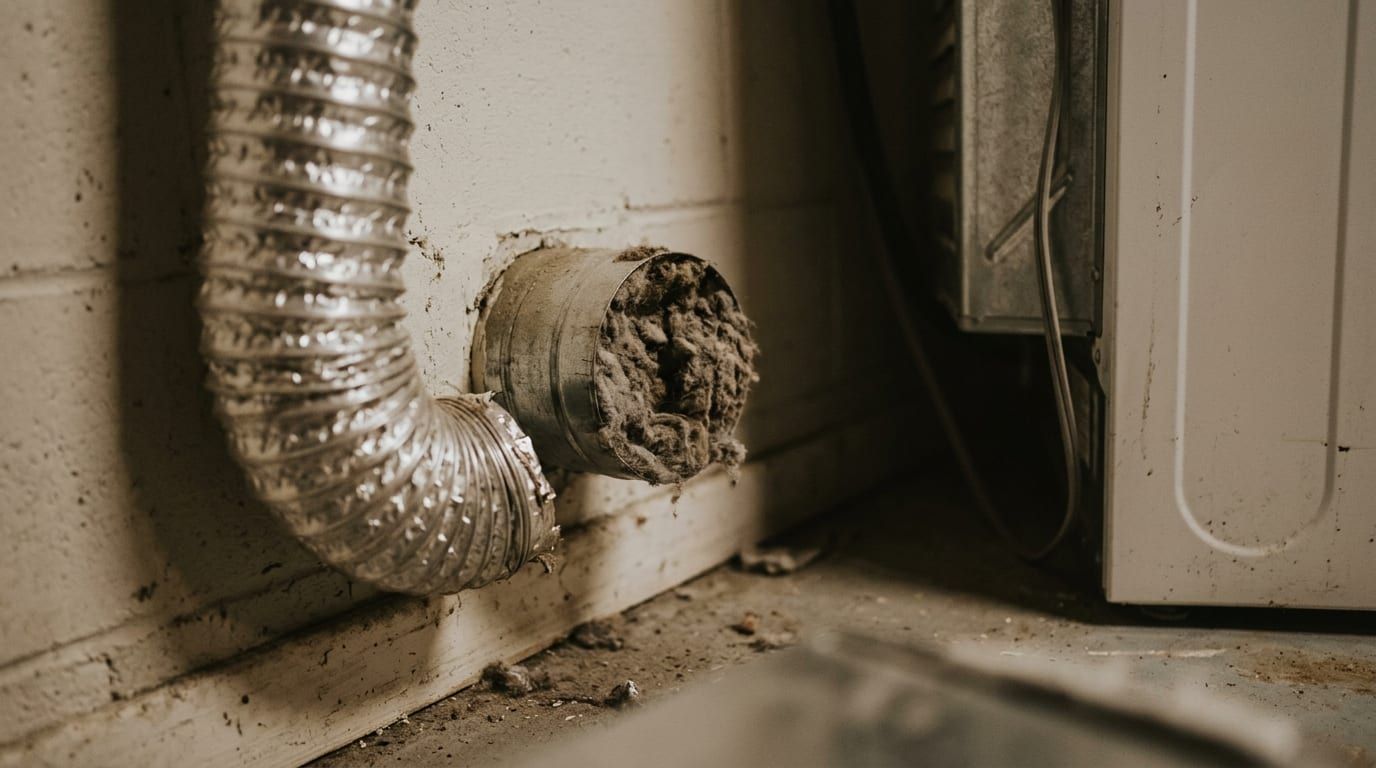
A dryer vent losing ground to lint shows up as a change in the dryer, not the duct: a load that used to finish in one cycle now needs two, the laundry room runs hotter and more humid partway through, and the flap on the exterior hood stops closing all the way because lint has built up behind it. Any one of those alone is worth a look. Together, they mean the exhaust run has narrowed enough that the dryer is working against real resistance on every load, and emptying the lint trap between cycles does nothing for lint that has already settled further down the duct.
When One Cycle Turns Into Two
A dryer that used to finish a load in under an hour and now needs closer to ninety minutes has not gotten weaker. A clothes dryer pushes hot, moist air out through the exhaust duct about as fast as the drum produces it; when the duct is clear, the air leaves close to that rate. Once lint has built up along the duct walls, the same volume of air has to move through a narrower channel, so less escapes per minute and more of the moisture that should have left with it stays in the drum. The controls respond the only way they can, by running the cycle longer, which is why the change shows up on the timer first.
- A load comes out heavier and slightly damp even though the cycle finished on schedule.
- An automatic sensor-dry setting keeps adding time to the same load instead of ending when expected.
- The change is gradual — it built up over weeks of ordinary use, not from one wash.
The Laundry Room Heats Up With It
The heat a dryer produces has to go somewhere. On a clear run, most of it leaves through the outside hood along with the moist air the drum is shedding. On a narrowed run, a growing share of that heat has nowhere else to go but back into the room — the top of the machine grows warm enough to notice by hand partway through a cycle, and the laundry room itself turns warmer and stickier than the rest of the house. That is not a separate problem from the longer cycle; it is the same restricted airflow, showing up as temperature instead of time.
What Collects at the Outside Hood
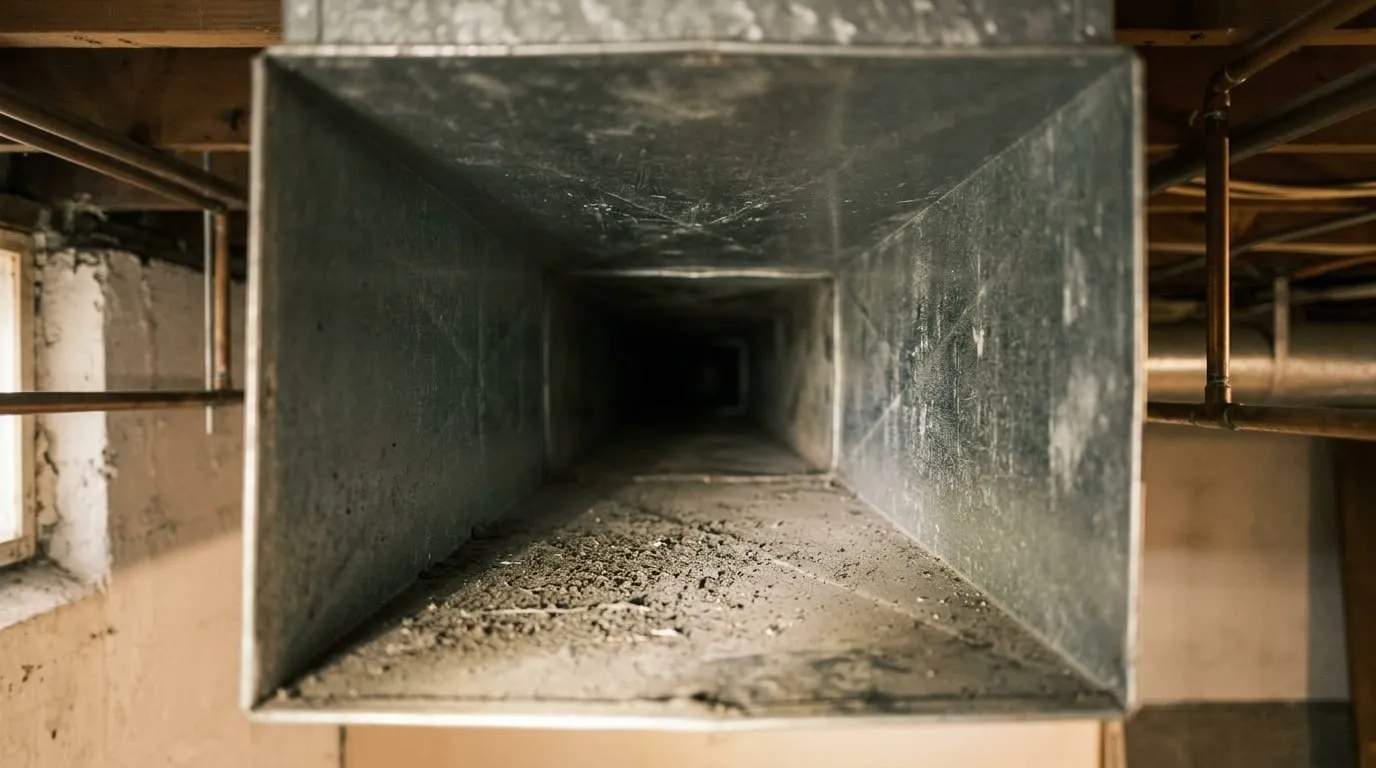
The exterior vent hood is the easiest place to see the evidence without opening anything up. It is built around a spring-loaded flap meant to swing open only while the dryer is running and sit closed the rest of the time, keeping rain and pests out of the duct. Lint that survives the whole length of the run collects right behind that flap, and it does not take much of it to hold the flap slightly open or keep it from lifting cleanly at all.
- The flap does not sit flush shut once the dryer has stopped running.
- Matted lint is visible around the outside edge of the hood itself.
- A hand held near the hood on a high-heat cycle finds only a weak, lukewarm push of air.
Why a Basement Run Silts Up Fastest
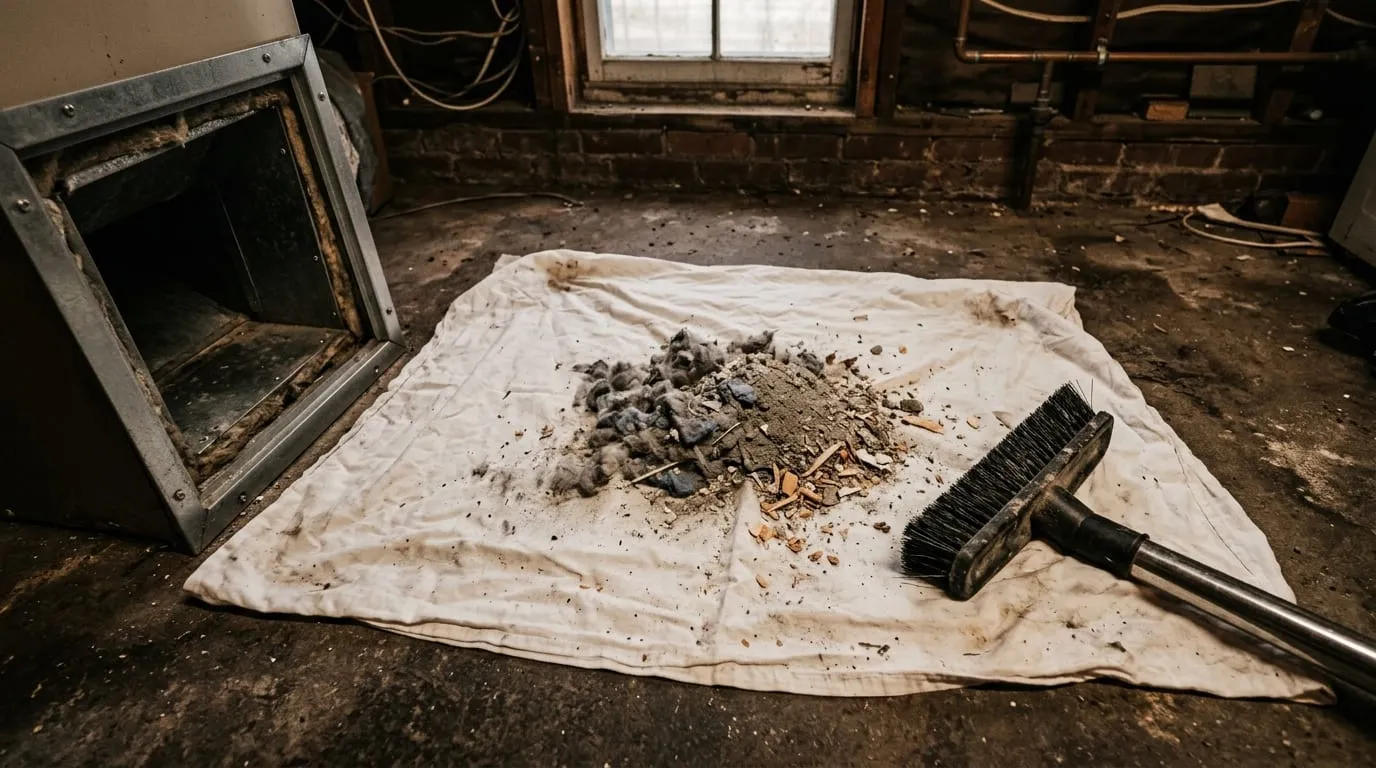
Airflow carries lint only as long as it keeps moving quickly. The moment it slows down — turning a corner, climbing a riser, or crossing a long flat stretch — some of what it was carrying drops out and stays behind, coating the duct a little more with every load. Along the lower ground near the Raritan, on Bridgewater’s Route 28 and Finderne side of town, a lot of that mechanical equipment — furnace, water heater and washer-dryer together — sits below grade, and a basement machine has to push its exhaust up and out rather than simply across, with an extra riser and turn to slow the air at every stage.
- The first elbow closest to the machine, where the air is still moving fast, usually stays the clearest.
- A long horizontal stretch under the floor joists, where the air has already lost speed by the time it arrives.
- The final rise up an exterior wall or through the roof — the slowest-moving air anywhere in the run.
The Length Limit the Duct Was Built To
New Jersey does not leave dryer duct length to guesswork. Section M1502 of the 2024 IRC — the edition the state now enforces for one- and two-family homes — caps a clothes dryer’s exhaust run at 35 feet from the machine’s connection to the outside hood, and it charges for every turn: five feet off that allowance for each 90-degree elbow, two and a half feet for each 45-degree elbow. A short, straight run barely touches that limit. A basement run that climbs and turns twice before reaching the hood can spend most of the allowance on fittings alone. That is not a defect — a run built right up to the limit is legal. It is a warning about margin: less room left before ordinary lint turns a legal run into a restricted one.
Common Questions About a Restricted Dryer Vent
Does cleaning the lint trap every load prevent this?
No. The trap catches most of what a load sheds, but never everything, and whatever slips through moves on into the duct instead of vanishing. Emptying the trap keeps the machine itself running safely; it does nothing for lint that has already settled further down the run.
Does a long basement-to-outside run always need more frequent service?
Generally, yes. A short, straight run gives lint almost nowhere to catch; a longer run with a rise and a couple of turns gives it several places to settle. Neither layout breaks any rule as long as the total stays inside what the code allows once elbow deductions are subtracted — but the longer one is worth checking on a shorter interval.
What does the 35-foot rule in the building code actually limit?
It sets the maximum distance a clothes dryer’s exhaust duct can run, from the machine’s connection to the outside hood, under Section M1502 of the 2024 IRC. Every 90-degree elbow counts against that total at five feet, and every 45-degree elbow at two and a half, so two or three turns can use up most of the allowance before the duct has gone anywhere. It is a construction limit, not a maintenance schedule.
Can a badly restricted vent actually be dangerous, not just slow?
A dryer starved of exhaust airflow runs hotter than it was designed to, since it has less moving air to carry that heat away. A scorched smell partway through a cycle means that is already happening. That is not something to wait out; it moves the conversation from drying time to the appliance itself.
This Explains the Symptoms, Not Your Vent
Everything above describes how a dryer duct behaves in general — it is not a look at the specific run behind your own machine, or how far lint has actually traveled down it. If your dryer has picked up a second cycle, if the laundry room runs hot, or if the outside hood is not swinging clean, tell us what you are seeing and we will look at the actual run, not just the symptoms it is producing.
What Actually Fixes This
Dryer Vent Cleaning
The whole run cleared, machine to hood, with the airflow checked at the outside vent before and after — not just the trap.
See the serviceAir Duct Cleaning
A separate system from the dryer run, worth doing in a handful of specific situations rather than on a fixed schedule.
See the service